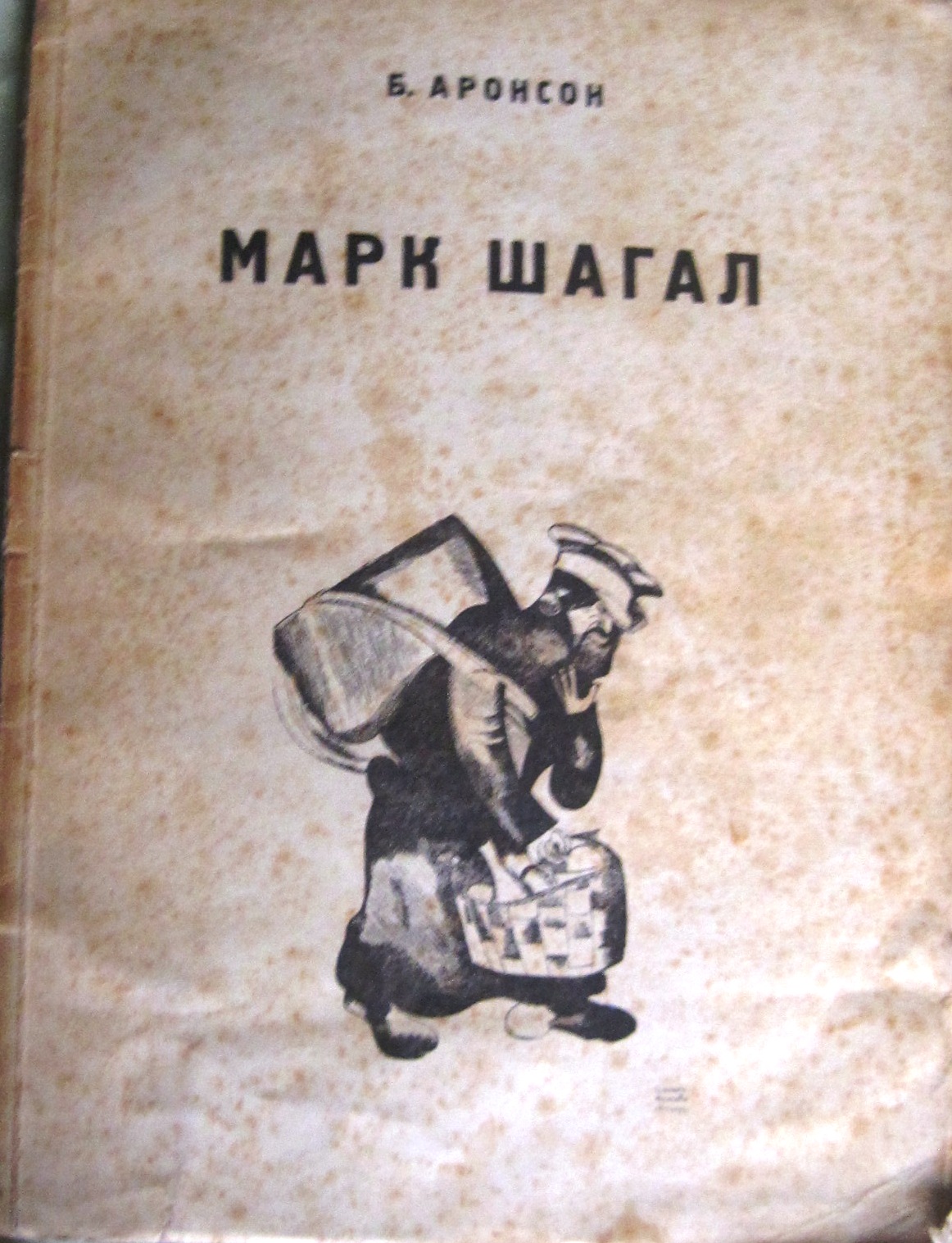
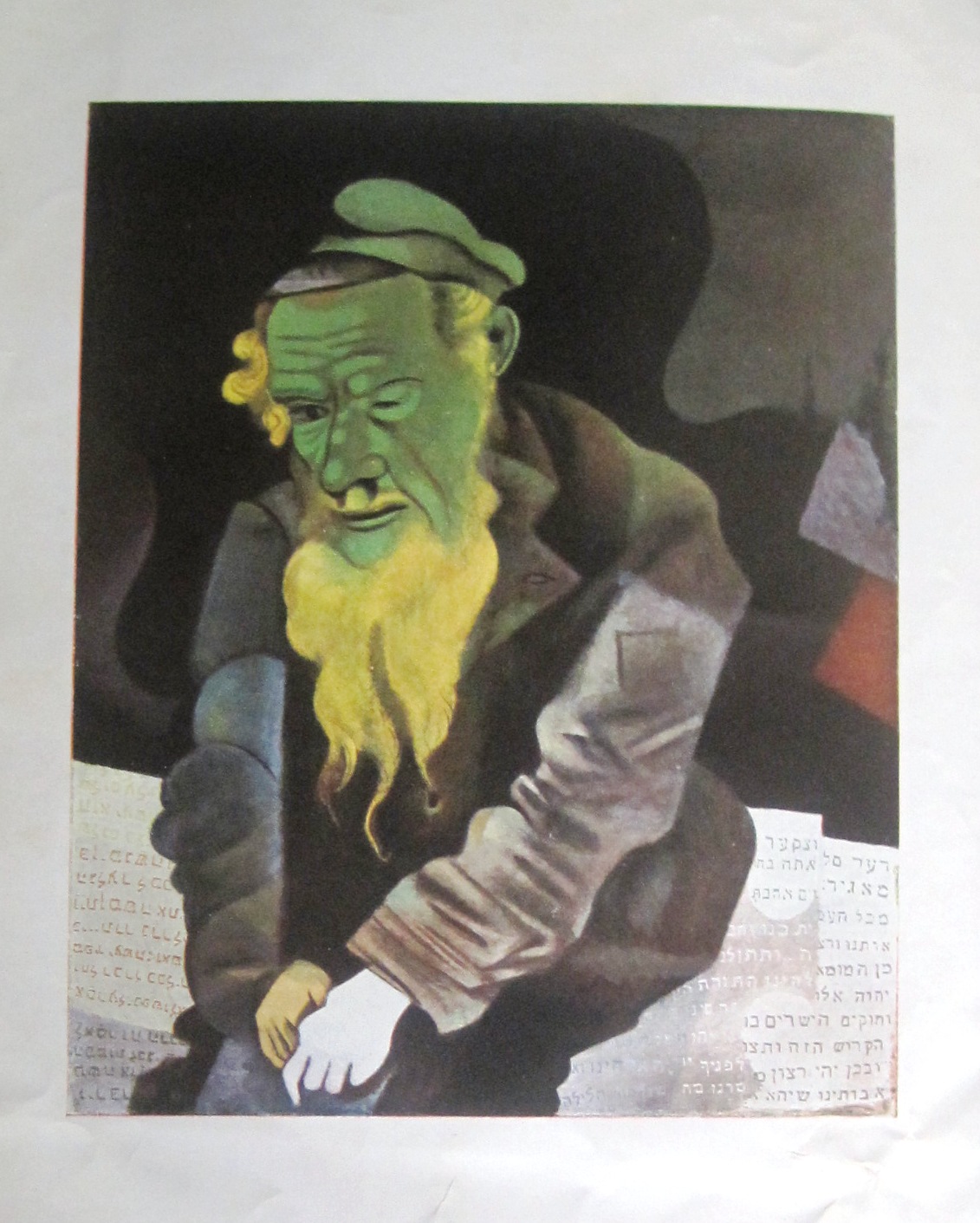
Marc Chagall was a Russian-Jewish
artist and writer in Yiddish who moved to France and
developed his highly original style by blending elements
of traditional Jewish culture with cutting-edge
innovations in modern art.
He was born Moishe Segal (Russified: Marc Zakharovich
Shagalov) on July 7, 1887, in Liozno, a suburb of
Vitebsk, Russia (now in Belarus). He was the first-born
of nine children in the traditional close-knit
Russian-Jewish family. Chagall's father and mother were
cousins. His father, Khatskel Segal, was a herring
merchant. His mother, Feiga-Ita, was a housewife.
Chagall studied Torah and Talmud in Hebrew with Rabbi
Ochre, and then with Rabbi Jatkin for basic education at
home. At that time Jews were not admitted to schools in
Russia, but Chagall's parents managed to get him
admitted by bribing a school principal. Chagall's
favorite classes were drawing and geometry.
Young Chagall made his first artwork for the Haggadah
for his family on Passover. Then he did a copy of the
portrait of composer Anton Rubinstein from the magazine
"Niva". His first job was as a photo-retoucher at the
photo studio of Meshchaninov in Vitebsk. Chagall briefly
studied in the cheder of the Zarechenskaya synagogue,
the biggest temple in Vitebsk. There he also sang as a
cantor's assistant and studied violin. He later took
painting lessons from Yehuda Pen in Vitebsk for two
months. In 1907 Chagall went to St. Petersburg. There he
studied art under Nikolai Roerich at the Imperial
Society of Art Supporters; then under Leon Bakst and
Mstislav Doboujinsky at Zviagintseva School of Art.
From 1910-1914 he lived in Paris on a stipend of 125
francs a month from a notable Russian-Jewish lawyer,
Maxim Vinaver. Chagall settled in the Montparnasse
community of La Ruche. There he associated with
Guillaume Apollinaire, M. Jakob, A. Salmon, Robert
Delaunay, Fernand Léger and others. During those four
years in Paris he witnessed the emerging new styles of
Fauvism, Cubism, Surrealism and various avant-garde
currents being created by Henri Matisse, Pablo Picasso,
Georges Braque, Amedeo Modigliani and Giorgio De
Chirico, as well as other leading artists of the time.
In May of 1914 Chagall went to Germany. There he became
acquainted with the artistic experiments of Wassily
Kandinsky. Chagall had his first solo show at the Sturm
gallery in Berlin. Then, after the onset of World War I,
he went back to Russia.
In May of 1915 Chagall married his first love, Bella
Rosenfeld, the daughter of a wealthy jeweler in Vitebsk.
She was the inspirational model for his famous series of
paintings with passionate flying figures. In 1916 the
Chagalls had a daughter, Ida. At that time he created
his most vibrant and youthful paintings depicting his
wife Bella flying with him in the skies above their
hometown of Vitebsk.
Chagall was appointed the Commissar of Arts in Vitebsk
Province after the Russian Revolution of 1917. He
organized the new Vitebsk Art School and also taught
there. He moved to Moscow in 1920. There he took an
active part in the stage productions of the newly formed
Moscow Jewish Theatre, of which he was the Art Director
from 1920-1922. Chagall designed the stage decoration
for the production of "Fiddler on the Roof", based on
the story by Sholom Aleichem. Chagall's work was marked
by surrealistic inventiveness and continued his
emergence as a cross-cultural artist.
In 1922 the Chagalls fled the troubled Russia and moved
to Berlin, then to Paris in 1923, as did many Russian
intellectuals. He published his book of memoirs with
illustrations in 1923. Then he made illustrations for
"Dead Souls" by Nikolai Gogol, and began illustrating
the Bible in 1930. In 1937 Chagall became a naturalized
French citizen. In 1941, however, the Chagalls fled the
German occupation of Paris and lived in New York until
1947. There Chagall designed decorations for the
production of "Firebird" with the music of Igor
Stravinsky and choreography by George Balanchine.
Chagall also made a stage set for "Aleko" with the music
of Pyotr Ilyich Tchaikovsky. In September of 1944 his
beloved wife and inspirational muse Bella died.
Back in Europe, Chagall settled in Provence, France. His
creativity was now inspired by his new love, Valentina
(Vava) Brodsky, whom he married in 1952. His works
during this period are marked with energetic and joyful
feelings, expressed by vibrant lines and vivid colors.
He expanded his creativity into sculpture, ceramics and
stained glass, making stained glass windows for several
Catholic and Protestant cathedrals in France,
Switzerland and Germany. In 1960 Chagall created
remarkable stained glass windows for the Synagogue of
the Hadassah Ein Kerem hospital in Jerusalem. In the
1960s and 1970s he decorated the new Parliament in
Jerusalem, the ceiling of the Grand Opera in Paris, the
lobby of the Metropolitan Opera House in New York and
the National Bank Building in Chicago with a series of
large-scale mosaic murals that define the language of
20th-century monumental art.
Mark Chagall died at the age of 97, on March 28, 1985,
in Saint-Paul de Vence, France, and was laid to rest in
Saint-Paul Town Cemetery, Provence, France.
Chagall's art is the pride of museum collections across
the world. In 1973, the Musee National Message Biblique
Marc Chagall (The Chagall Museum) opened in Nice,
France. The Chagall family home on Pokrovskaia street in
Vitebsk was turned into a memorial museum in 1992 and
decorated with copies of his works in 1997.
Spouse
| Valentine Brodsky |
(12 July 1951 - 28 March 1985)
(his death) |
| Bella Rosenfeld |
(25 July 1915 - 2 September 1944)
(her death) 1 child |
Trivia
Daughter Ida born 1916.